|
Home |
Watch Kate Tell |
What's New |
Calendar |
Bio
Adult Programs |
CDs |
Free Newsletter
Articles |
Reviews |
Publications |
Press Kit |
Contact
Getting
to the piece that matters
First published August 15, 2002, on http://www.femalesinthenews.com
Talking
with Kate Dudding about storytelling is a little bit like talking with
a child about Santa Claus. They both communicate awe, excitement and enthusiasm
that is both genuine and endearing. A computer programmer “by day,”
Kate’s number one and all-consuming hobby is storytelling.
We
know that stories are entertaining. And while Kate celebrates the quality
of amusement in many stories, she's also very serious about other applications
of the artform, which are available to us all: utilization of mentorships
and networks and enhancement of our ability to learn and present information.
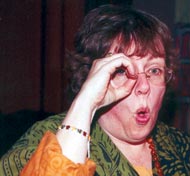 The
dragon ghost. B-17s (the greatest plane God ever made). An alligator purse.
The father of standard time. That's the short list of some of the fascinating
subjects Kate Dudding knows through story. Her passion for
the craft of storytelling is matched only by her dedication to getting
better at it. The
dragon ghost. B-17s (the greatest plane God ever made). An alligator purse.
The father of standard time. That's the short list of some of the fascinating
subjects Kate Dudding knows through story. Her passion for
the craft of storytelling is matched only by her dedication to getting
better at it.
In
listening to her share the details of what has become her second profession,
it is clear that Kate’s pursuit of storytelling is about more than learning
how to convey characters, plots and morals. It’s about finding what you
love and doing it well. It’s about sharing an experience with the listeners
and enjoying the company of fellow storytellers.
And
since oral story can’t be too lengthy, it’s about getting to the piece
that matters. Before you can communicate what matters in our experiences
(stories), you have to know what matters. For Kate, sometimes it’s
connecting with a mother-figure in a story or appreciating the richness
and color of life; other times it’s just finding pleasure from an “amusing
little story.” She says, "All the teachers I've had say,
'You need to find your own voice.' I take that to mean you need to find
the things that are important for you to tell. Find a story you love. If
you don't love it, it's just not going to work."
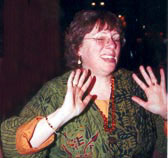 Kate
believes that stories are important in our ability to learn, retain and
present information. She says that in her experience, people try to learn
facts and commit them to memory, but she says stories "tell us more than
just the facts ever would have," making the information more memorable
for the presenter and audience (in a business setting, for example). Kate
believes that stories are important in our ability to learn, retain and
present information. She says that in her experience, people try to learn
facts and commit them to memory, but she says stories "tell us more than
just the facts ever would have," making the information more memorable
for the presenter and audience (in a business setting, for example).
Her
method for developing and practicing her stories is equally applicable
to business. Kate uses the internet and libraries to research stories and
also accesses her network (storytellers and friends) for information on
specific characters, themes and topics. Once she has all the pieces, she
tries to put them together in a way that is interesting and logical, but
also interesting.
Even
though the process can be quite extensive, she says, "I try not to write
it down. I record it and listen to it and work from that. I find I'm best
composing if I'm on my feet and moving. If I'm walking around and telling
a story, words come out of these characters. It's getting in touch with
things I've heard. I'm not trying to memorize it, but just mulling it over."
Living with the story gives Kate a familiarity with her subjects and stories,
making her delivery seem natural, inventive and even spontaneous. It also
prevents her from needing notes, which is discouraged in storytelling:
"The connection with the audience is more important than getting every
little detail in exactly the spot you intended."
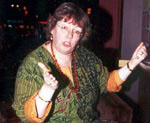 One
"trick" of the trade that comes into play in this process is, instead of
memorizing the stories word for word, picturing a series of images and
describing those to the listeners/audience. She says she just tries to
remember what pictures follow what, and if mid-story she realizes she left
something out, she say, "It's important for you to know now that . . ."
or "And you must remember that . . ." One
"trick" of the trade that comes into play in this process is, instead of
memorizing the stories word for word, picturing a series of images and
describing those to the listeners/audience. She says she just tries to
remember what pictures follow what, and if mid-story she realizes she left
something out, she say, "It's important for you to know now that . . ."
or "And you must remember that . . ."
Kate says storytelling
“seems to call into play a lot of my talents: being organized, [having
a] love of research, and I’ve always had a loud voice. I have a good memory.”
Even armed with the confidence of knowing these strengths, public speaking
and creative expression can still be scary, but Kate performs well because
she knows, “It’s not about me. It’s about the story and to me that takes
the pressure off. If I sing (I’m not a trained singer), it’s just part
of the whole experience and if my voice cracks it’s OK, they’re not here
to hear my voice.”
She also does well
because she is committed to improving her skills through active consultation
of her mentors. "It's hard for me to imagine people becoming storytellers
without knowing storytellers. My teachers have taught me so much." Kate
describes one of the most important lessons in storytelling: "In England,
the storytelling tradition is to reproduce traditional stories, but here,
most tellers try to find their own truth in the story. A new teller hears
a story and says, 'I want to tell that story.' A more experienced teller
says, 'I liked that story. I have to try to find my own like that." She
says the object is to "bring your own stuff to it."
Listeners do the
same, says Kate. "I think it's nifty that I tell one story and everyone's
hearing their own. It's being filtered through their lives. If I say, 'There
was an old barn,' I'm thinking about the old red barn on Grooms Road that
has the date in the slate roof. But you might be thinking of a stone barn.
People bring to the story and take away from the story. The exchange
enriches my telling. "
A resident of Clifton
Park, NY, Kate Dudding
began telling stories when her son was four (he's 16 now). She has a B.A.
in psychology and French and an M.S. in computer science, which was the
start of 30 years in the industry. In addition to performing at The
Egg, Cafe Lena, Glen Sanders Mansion and "Tellabration," Kate tells stories
for people of all ages in schools, libraries, professional organizations,
community and senior centers, fairs, festivals and birthday parties.
Kate serves on the organizing
committee for the First Annual Riverway Storytelling Festival and she is
co-founder of the Hudson Valley Storytelling Alliance. She holds membership
in the National Storytelling Network, the League for the Advancement of
Storytelling, Story Circle of the Capital District, the Saratoga County
Arts Council and the Albany/Schenectady League of Arts.
|