|
Home |
Watch Kate Tell |
What's New |
Calendar |
Bio
Adult Programs |
CDs |
Free Newsletter
Articles |
Reviews |
Publications |
Press Kit |
Contact
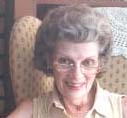
I love saying my mother's name out loud: Lucile Ellen Elliot Eike.
She called me her favorite daughter. Then again, I was her only daughter.
But I'll return the compliment -- she was my favorite mother.
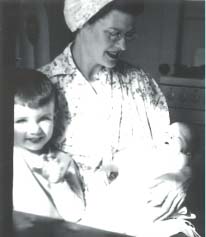
She died in 1987. Several years ago, I became very concerned.
Whenever I was remembering what she looked like, I found that I was
remembering a photograph of her. It seemed as if I had forgotten what she
looked like through my own eyes. This really bothered me. I was afraid that
she was slipping even further away from me.
But then, I remembered her hands. And there are no photographs of them.
My mother's hands were thin, there wasn't much meat on them. You could
see the bones and veins through the translucent skin on the backs of her
hands. She had long, slender fingers. She let her nails grow about 1/4" be-
yond her fingertips, and she filed her nails into delicate ovals. She always
wore her platinum wedding band, and as long as she wasn't doing anything
dirty or wet, she also wore her matching engagement ring, with its round,
brilliant cut diamond.
The more I thought about her hands, the more I remembered.
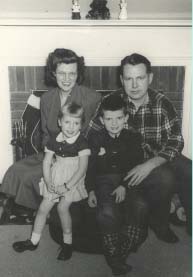
I remember the feel of her hand on my forehead when she was checking to
see if I had a fever. I remember how she rubbed my back when I was sick.
Well, actually, she rubbed my back while I threw up in the toilet. I remember
the way she'd spot a hair that had fallen on my shoulder, and the way she'd
pick it up and quickly rub her fingers together so the hair would fall to the
floor.
I remember my mother's hands while she played the piano, both by herself
and when we played duets together.
She loved Broadway show tunes. Her
favorite song was "You'll Never Walk Alone" from the Rodgers and
Hammerstein show "Carousel". The first arrangement we had was in a chil-
dren's music book and it was just too simple. "That left hand isn't right. It's
supposed to be a rolling left hand, not chords."
So she sat down, figured out
the notes, and wrote them in the book using a blue ball-point pen. Then one
Christmas my father bought her a large, bound volume of all of Rodgers and
Hammerstein songs. She approved of the arrangement in that book.
I remember her waving to us as we drove up to the house, and as we left. If
we were parking in the front of the house, she stood behind the storm door.
If we parked in the driveway behind the house, she was in the window in the
kitchen, next to the pantry, which overlooked the driveway.
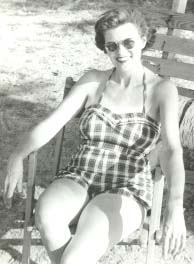 Sometimes after
waving, she would hold up her right index finger and wag it a few times,
which meant that she had an important announcement. Usually when we
were arriving, the announcement was that my husband was parking in an
illegal spot. We shared a double driveway with the people next door.
There was only one spot on our side of the driveway where my mother allowed people to
park their cars. It took my husband several years to learn exactly where that spot was, to my mother's satisfaction.
Until then, she directed him, from the window, using her hands.
Sometimes after
waving, she would hold up her right index finger and wag it a few times,
which meant that she had an important announcement. Usually when we
were arriving, the announcement was that my husband was parking in an
illegal spot. We shared a double driveway with the people next door.
There was only one spot on our side of the driveway where my mother allowed people to
park their cars. It took my husband several years to learn exactly where that spot was, to my mother's satisfaction.
Until then, she directed him, from the window, using her hands.
If my mother held up her index finger as we were leaving, the announcement
usually was: "Remember, please call me when you get home." "Yesss,
Mmmother," I condescendingly replied. I didn't understand how parents
worry about their children until my son was born.
I remember my mother's hands while she was knitting. She knit countless
sweaters for my father, my brother and me.
She also made clothing for my
cousins. When Lee Ann started skating lessons, my mother made her a long,
long skating hat, with stripes of many different leftover yarns. This hat was
so long that Lee Ann could wrap it around her neck a few times as a scarf if
she was cold. When Laurel graduated from high school, she and my mother
went to Cederbaum's Yarn Shop in Bridgeport, where my mother bought yarn
for 30 years, and they picked out a sweater pattern and some orange mohair
yarn. When her brother Lance graduated from high school, he picked out some
heathery, greyish blue yarn and an Aran Isle pattern. Whenever my mother
saw him, she'd whip out the sweater for a fitting. Lance wrote me recently,
"It's probably the only graduation gift that I still have and use. It's up on the
sweater shelf to this day, and whenever it's cold out, and I need to wear
something special, the handiwork of Aunt Cile still warms my body and soul."
My mother would usually knit while she watched TV.
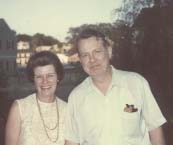 She was fascinated by
the space program, and watched all the Mercury, Gemini and Apollo space
missions on our black and white TV, listening to The Voice of Mission Control
while she knit. Once she was making me some gold mittens, with a cable on
the back. Knitting patterns usually only give complete directions for the right
side of the garment. For the left side, the directions start you out, then say,
"Complete this side following the directions for the right side but reversing all
increases and decreases." During this very absorbing space mission, perhaps
Apollo 13, my mother forgot to reverse the instructions, and didn't notice until
she had finished making the second right mitten with the cable on the back.
Luckily she had enough yarn and made me two matching left mittens. She
rarely made mistakes like that, however.
She was fascinated by
the space program, and watched all the Mercury, Gemini and Apollo space
missions on our black and white TV, listening to The Voice of Mission Control
while she knit. Once she was making me some gold mittens, with a cable on
the back. Knitting patterns usually only give complete directions for the right
side of the garment. For the left side, the directions start you out, then say,
"Complete this side following the directions for the right side but reversing all
increases and decreases." During this very absorbing space mission, perhaps
Apollo 13, my mother forgot to reverse the instructions, and didn't notice until
she had finished making the second right mitten with the cable on the back.
Luckily she had enough yarn and made me two matching left mittens. She
rarely made mistakes like that, however.
Two years after my father died, my mother had an 8 hour cancer operation.
When I saw her in the Intensive Care Unit, she really wanted to tell me
something, but with the breathing tube, she couldn't talk. It was difficult for
her to write because of the drugs and she didn't have her bifocals. The only
words I understood were "died", "father", "sweater".... That made no sense to me.
Several days later, the breathing tube was out and she could tell me what she
had been trying to communicate, but she wasn't so anxious to tell me any more. Sometime
during her operation, she thought she had died, and she had had a vision of
life after death. Now it wasn't the standard one that you may have heard of,
with a long dark tunnel with a warm, welcoming light at the end.
My mother told me, "I saw a river. Your father was standing on the other side of the
river, waiting for me. But he was wearing a handmade sweater that I
hadn't made, and I wanted to know WHO had made HIM that sweater!"
I asked, hesitantly, not knowing exactly what all the drugs floating around in her body were doing to her mind, "Mother, you do remember that he couldn't take any of your
sweaters with him?"
"Yes, I know", she replied with a laugh. So we discussed the situation for a while and decided
that there must be some sort of society of designated knitters in the afterlife which makes sweaters
for people whose family knitter has yet to arrive.
Yes, I remember my mother's hands.
I'm reminded of them when I look at my own hands; they're the same shape,
and the bones and veins are beginning to show through the skin.
 I'm
reminded of her hands when I see my sister-in-law Betsy's hands, because
Betsy's engagement ring has my mother's diamond in it. I'm reminded of my
mother's hands when I'm playing songs from her music books, and when I'm
knitting sweaters for members of our family.
I'm
reminded of her hands when I see my sister-in-law Betsy's hands, because
Betsy's engagement ring has my mother's diamond in it. I'm reminded of my
mother's hands when I'm playing songs from her music books, and when I'm
knitting sweaters for members of our family.
So I'm not bothered anymore if I need to refer to a photograph or a tape to
remember some physical characteristic of my mother.
You see (as I hold up
my right index finger and wag it just like she did), I know I remember my mother's
hands. And I know I remember my favorite mother too.
Copyright 1997 Kathryn Eike Dudding. All Rights Reserved.
|